

There Will Never Be Another One
Play #023: David Beckham didn't just play the game. He changed the game. And then he changed the business of the game. And then he did it again.

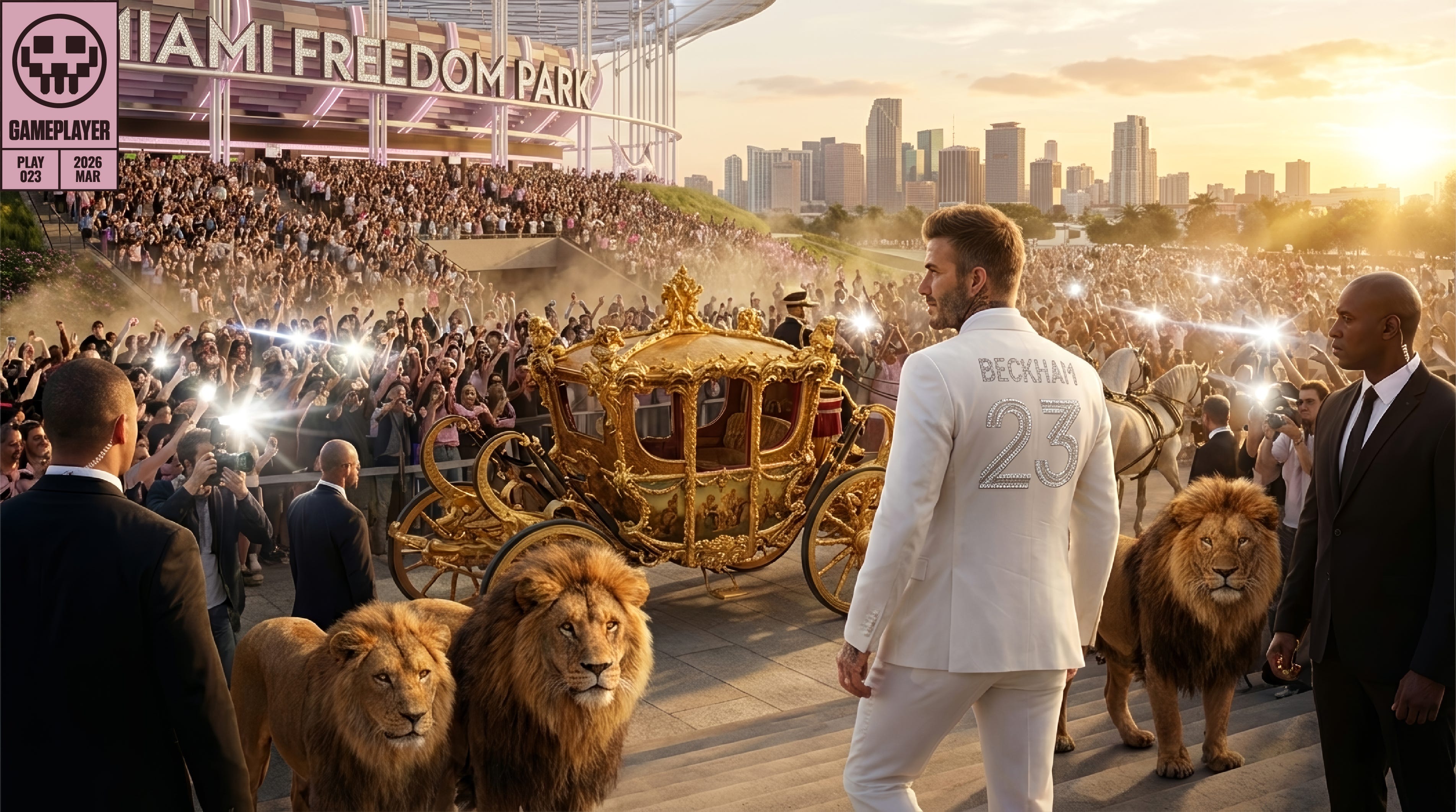
I rewatched the Netflix documentary a few times last week. I’m not ashamed to admit something may have gotten in my eye. Not at the obvious bits. At the free kick against Greece. The build-up, the weight of it, what was riding on that moment, and who was standing over the ball. By the time it hit the net I was gone. Three lions. Off my couch. Fist pump. Thirty years of hurt. Sixty six and all that.
But rewind first. Because people forget, or maybe never fully appreciated, what preceded all of it.
After the red card against Simeone at France 98, Beckham spent an entire season as one of the most hated men in the country. Not disliked. Hated. Booed at every ground in England. An effigy hung outside a pub in London. The tabloids treating him like a national embarrassment. He was twenty-three years old. And if that wasn’t enough, Hoddle dropped him from the England squad entirely. Gone. Discarded. And then, years later, the same shirt, a different manager, and they gave him the armband. The lead lion. That arc alone is a film. Someone tell Fulwell Productions. That fearlessness never left him, you can see it in every room he walks into, every camera he faces, every business he builds. There’s a man who got knocked down in the most public way imaginable and came back bigger. They don’t make them like Becks anymore. Sir Goldenballs of steel.
Let’s start with a number that still doesn’t feel real.
Florentino Pérez is not a man who throws superlatives around. He’s a Spanish construction billionaire who runs the most powerful football club on the planet with the warmth of a planning application. So when he sat down in front of a Netflix camera and said, on the record, that Beckham tripled Real Madrid’s revenues in the year he arrived, I paused it. Hit rewind. Made sure I’d heard it correctly. I had. Not grew. Not boosted. Tripled. I couldn’t get it out of my head.
I went looking for hard numbers to support tripled and couldn’t find anything that confirmed it cleanly. What I found instead was arguably more interesting. Bear in mind the context. This was the Galácticos era. The same dressing room as Ronaldo, Zidane, Figo, Roberto Carlos, Raúl. The most celebrated collection of footballers ever assembled in one place. Within his first six months in white, Real Madrid sold over a million shirts bearing his name and the number 23. That number 23 shirt alone accounted for over 50 percent of all Real Madrid jersey sales that season. The Real Madrid kit became the highest selling non-domestic jersey in England, with sales up 350 percent on the year before. And before he’d played a single competitive league game, his first pre-season tour with the club, 18 days across Beijing, Tokyo, Hong Kong and Bangkok, earned Madrid €10 million from exhibition matches alone, on top of a six-year commercial deal with Asia Sports Development worth a guaranteed minimum of €22 million in its first three years.


By the end of his time at the Bernabéu, Madrid had leapfrogged Manchester United to become the world’s richest football club, a position United had held since the Deloitte chart was created nine years earlier. Deloitte’s sports business partner Dan Jones said it plainly: “You can’t put a figure on his impact. He’s the most famous player in the world.”
That is the Beckham effect.
But the numbers only tell half of it. What they can’t capture is what happened when Real Madrid landed in Asia that summer.
Madrid had never done this before. Not like this. They were late starters compared to Manchester United in the push for Asian markets, and they knew it. So they took their entire Galácticos squad, Zidane, Ronaldo, Figo, Roberto Carlos, and they put Beckham at the front. Beijing first. 50,000 people inside the Workers’ Stadium, sold out. Thousands more outside who couldn’t get in. The Spanish sports daily Marca ran the headline: “Beckham-mania in China.” Chinese journalists, comparing the reception to previous tours by AC Milan and Sampdoria, noted that Real Madrid’s squad had become more of a tourist attraction than the sightseers themselves. Then Tokyo, 1,200 fans waiting at the airport alone before they’d even left the terminal. Then Hong Kong. Then Bangkok, 60,000 inside the stadium holding candles in the dark for the Queen of Thailand’s birthday, with Beckham among them. The whole tour was compared to The Beatles’ first visit to the United States in 1964.


A supporter from Spain, interviewed pitch-side in Bangkok, said it as plainly as anyone: “The main attention here in Asia is Beckham. It is Beckham and Manchester. Real Madrid is very popular in South America, but here, it is Beckham.”
He didn’t just open new markets for the club. He was the market.
And before we go any further, let’s put some respect on the footballer.
Because it’s easy, in a piece like this, to let the commercial story swallow the sporting one. Beckham was not just a brand in boots. He was elite. Properly, genuinely elite. Six Premier League titles. A Champions League. La Liga in his final season at Madrid. Even a cameo at PSG was enough to end with a Ligue 1 title in his back pocket, their first in 19 years. Ninety-five caps for England, forty of them as captain. In an era that produced Zidane, Figo, Ronaldo, Nedvěd, he was consistently regarded as one of the best in the world at what he did. His delivery from wide positions, his range of passing, his dead ball ability, were things coaches still use as reference points today.
Every kid in the country wanted to curl it top bins like Beckham. If you didn’t have the curtains haircut at school, or a tube of Brylcreem somewhere in the bathroom, who even were you. He made the right side of midfield aspirational. He made crossing aspirational. He made working hard at something until it looked effortless aspirational. Shirt sales don’t help you perform on the grass. The football was real.
The brilliance of what came after is that he built something even bigger than the game he was brilliant at. But never mistake one for the other.
None of that was handed to him.
This wasn’t a man who turned up talented and watched the world arrange itself around him. Beckham worked for every inch of it. Free kick practice at The Cliff long after every other United player had gone home. Pre-season tours in Asia, leaning into a frenzy most players would’ve quietly avoided. Interviews in countries most footballers couldn’t point to on a map. The fashion choices, deliberate, brave, occasionally ridiculous, that kept him permanently in the frame and permanently in conversation.
He wore a sarong. In 1998. Outside a restaurant. And somehow, that became cool.


He shaved his head into a mohawk and the tabloids lost their mind, which of course meant every teenage boy in England got one too. Me and my two brothers included. He painted his nails. He modelled in a skirt. He was unapologetically himself at a time when footballers were largely expected to score goals, avoid controversy and be grateful for it. The courage that takes, the social cost in a very particular dressing room culture, doesn’t get talked about nearly enough.
And then there was the number 23.
Raúl had the 7 at Madrid. Another player might’ve taken the 8 and moved on. Beckham chose 23 and immediately linked it publicly to Michael Jordan, one deliberate move that connected football’s biggest crossover star to basketball’s greatest cultural icon in a single gesture. Within one season, Los Blancos made $24.5 million through Beckham jersey sales alone. That wasn’t coincidence. That was brand strategy.
Lionel Messi is the greatest footballer who ever lived. Say it plainly, because it’s true, and because the comparison only lands harder when you’re honest about it. Eight Ballon d’Ors. A World Cup. The ability to do things with a football that still don’t make complete sense even after you’ve watched them back. By any on-pitch metric, Messi makes Beckham look ordinary.
Off it, it’s not even close.
Messi arrived at PSG and shirt sales ticked up, then went quiet. He left Barcelona and the story was grief, not movement. He has over 500 million Instagram followers and still somehow doesn’t shift a room the way Beckham does walking into one. None of that is Messi’s fault. He is who he is, brilliant and private and completely uninterested in the performance of celebrity. But that’s exactly the point. Cultural leadership at the level Beckham operated isn’t a gift that comes packaged with talent. You can be the most gifted human being to ever kick a football and have absolutely no instinct for it. Messi proved that.
What Beckham had was curiosity. A genuine, restless interest in the world outside football. Fashion, music, culture, people. He didn’t sit front row at shows because his PR team booked the seat. He sat there because he wanted to be there. He moved through those worlds with the ease of someone who belonged, not someone on a visitor’s pass. That’s what people felt. That’s what they followed.
Which raises the obvious question. Can any of this happen again?
I don’t think it can. And social media is a big reason why.
There’s a version of the argument that says more access equals more influence, more followers, more reach, more touchpoints. But access without mystery is just content. And content, however well-produced, is not culture. Ogilvy’s 2026 trends report put it plainly: social is entering a new phase where meaning, not attention, is the real competitive edge. A shift from the attention economy to the intention economy. Beckham, operating twenty years before anyone wrote that sentence, already understood it instinctively.
Michael Jordan never had a social media account. He became the single most famous sporting icon on the planet in an era where the only way you experienced him was through television, magazines, and word of mouth. At the time of his 1990s athletic peak, before the internet and social media splintered global attention, Jordan achieved a level of worldwide fame that now seems almost unattainable. A UCLA professor who spent years studying his legacy called him “one of the last remaining figures of the monoculture.” There will never be another one, because the monoculture doesn’t exist anymore. Attention is too fragmented. The algorithm rewards frequency over mystique. The more you post, the more ordinary you become.
Today’s athletes are everywhere. That’s precisely the problem.
There are generations of kids who have never watched a single Michael Jordan game, who weren’t born when he retired, who still wear the Jumpman as a badge of something. Not nostalgia. Cool. Real, earned, intergenerational cool. Jordan Brand generated $7.27 billion in revenue in Nike’s 2025 fiscal year, for a man who hasn’t played a professional game in over twenty years. That is what iconography does. That is what scarcity does. That is what mystery does. You cannot manufacture that in an era of daily Stories and content drops and brand partnerships announced every other week.
Beckham understood this instinctively. He was present, but never overexposed. Visible, but never exhausting. He let the gaps breathe.
And the ambition. Let’s not skip the ambition.
Beckham was the first elite footballer to genuinely, consciously, publicly pursue life beyond the pitch while still playing. Not as a retirement plan, as an extension of who he was. He signed with Simon Fuller, the man behind the Spice Girls and American Idol, while still at Madrid. He negotiated an ownership stake in a future MLS franchise as part of his Galaxy deal, before anyone really understood what that meant. He built Brand Beckham as a parallel architecture to his football career, and when the football ended, the brand didn’t miss a beat.
That takes a courage most athletes simply don’t have. The dressing room judgment is real. The media ready to frame you as distracted, too big for your boots, more celebrity than sportsman, that’s real too. Beckham took every shot and kept moving.
Today, clubs, federations, agencies, and everyone in between has entire departments dedicated to building commercial audiences and digital revenue streams. All doing, at scale and with budget, what Beckham worked out largely alone in the late 1990s while people were telling him he was getting too big for his own good. Including Sir Alex himself.
He was just early.
Which makes what’s happening in Miami right now feel poetic in a way only his life can pull off.
The World Cup lands in the United States this summer. Miami, his city, is one of the host cities, seven matches there, including the bronze final. And this is also the year Inter Miami, his club, his decade-long fight to make football real in that city, moves into Miami Freedom Park, a 25,000-seat stadium at the centre of a $1 billion development including a hotel, restaurants, retail, and 58 acres of green space.
He fought for that franchise for years. Planning rejections, political obstacles, stadium site changes, public votes. And now the World Cup comes to his city in the year his stadium opens.


There’s a generation of American kids who will fall in love with football this summer and have no idea where to place it yet. I wrote about what that really means.

Some of them will end up at Inter Miami games. Some will hear the Beckham name for the first time not as a footballer but as the man who built their club, who believed in their city, who helped bring the world’s game to their front door.
That’s the thing about legacies that are genuinely built. They don’t stop. They take new shapes.
There will never be another Beckham because the conditions that made him don’t exist anymore. The era, the restraint, the courage, the curiosity, all of it converging in one person at exactly the right cultural moment.
Some might argue Cristiano Ronaldo came closest. And they wouldn’t be wrong to. He built something genuinely remarkable. CR7, the hotels, the fragrance, the biggest social media following of any human being on the planet. He understood the proof Beckham left, that a footballer can be more than a footballer, that a brand can outlast a career. But there’s a difference between building a brand around yourself and moving culture. Ronaldo made Ronaldo cool. Beckham made everything around him cool. That’s a different thing entirely.
The blueprint is still there. Unclaimed.
Whilst you’re here, a few more worth your time.


I don’t just write about the future of football, I help shape it. If this hit a nerve, I’m probably already thinking about how we could build something together.
Thanks for reading GAMEPLAYER.
Through CAOS, GAFFER, EDEN, and over 100 football contracts, transfers, brand deals, and equity-driven partnerships, I’ve seen power shift from clubs to investors, brands to athletes, and legacy to culture.
I break down what matters. Private equity takeovers, athlete-led media, billion-dollar sports IP, and the future of merchandising and streaming.
This isn’t just commentary. It’s about who’s making the real moves and what’s coming next.
Interesting analysis. Beckham played at a time before the game understood what he represented, and operated in the gaps that still existed. That is why it feels not only exceptional but also unrepeatable.
Becks played a part in changing how franchising looked, real influence is all about moving smart not loud